
Field Notes • Wilderness Skills • Tracking
The Quiet Art of Tracking Animals in Difficult Terrain
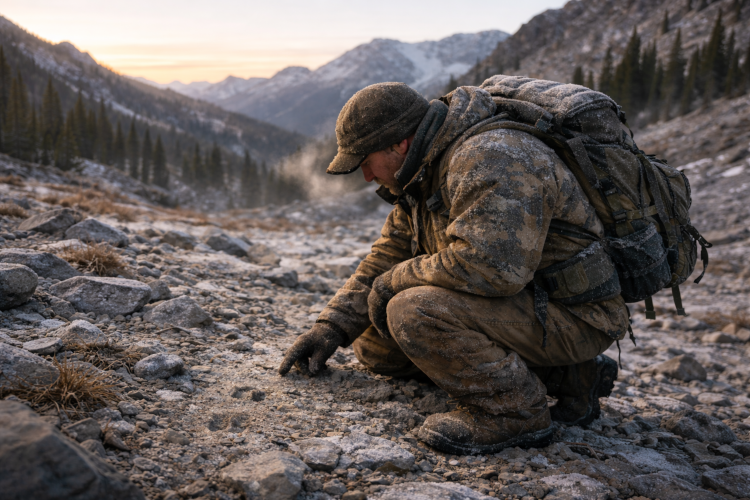
There’s a moment, usually early, when the light is thin and the ground hasn’t decided what it wants to reveal—when tracking stops being about feet and starts being about listening.
Not listening with your ears.
Listening with your eyes, your patience, and your willingness to slow down when everything in you wants to move faster.
Tracking animals in difficult terrain isn’t flashy. It doesn’t reward hurry. And it absolutely does not care how expensive your gear is or how many videos you’ve watched. What it cares about is whether you can read a story written in fragments and whether you’re humble enough to accept when the page goes blank.
This is the quiet art. The old one. The one that still works when the ground is frozen, the rocks are sharp, the wind scrubs everything clean, and the animal you’re following has lived its entire life avoiding exactly what you’re trying to do.
A Quick Word on Ethics and Respect
Before we go any further, let’s set something straight.
Tracking isn’t just for hunting. It’s for understanding movement, learning terrain, reading pressure patterns, and deepening respect for wildlife. Indigenous trackers, biologists, search-and-rescue teams, and backcountry professionals all rely on these skills.
If you hunt, do it legally, ethically, and with respect. If you track to learn, learn quietly. If you track for survival knowledge, remember that every animal you follow is a master of its environment not a target.
The land notices how you move through it.
Why Difficult Terrain Teaches the Best Lessons
Easy ground lies to you.
Soft dirt, mud, and perfect snow give you clean impressions and straight answers. Difficult terrain rock, shale, frozen ground, leaf litter, crusted snow forces you to read absence as much as presence.
That’s where real skill lives.
In hard country, you learn to:
- Read pressure instead of prints
- Notice disturbance patterns, not shapes
- Think in movement corridors, not footprints
- Track with your head, not your knees
And once you learn it here, it works everywhere else.
The Tracker’s Mindset: Slow Is Fast
“The animal already knows how to move here. You’re the one who needs to learn.”
The biggest mistake new trackers make in difficult terrain is rushing to “find sign.”
Experienced trackers do the opposite. They stop. They scan. They let the land explain itself.
Before you ever put your eyes on the ground:
- Note wind direction
- Read slope and exposure
- Look for travel corridors
- Identify feed, water, and escape routes
Animals don’t wander randomly. Even prey species move with intention. In broken terrain, they choose paths that conserve energy, protect visibility, and provide quick exits.
Your job is to think like something that wants to survive.
Footwear Matters More Than You Think (Early Gear Note)
When terrain turns hostile scree slopes, frozen ground, wet leaf litter your ability to move quietly and safely becomes part of the tracking equation.
This is where serious footwear earns its keep. A stiff, waterproof boot with real traction lets you stop where sign appears instead of sliding past it. I’ve had excellent results in rough country with rugged backcountry boots designed for wet, uneven ground, like those built by Muck Boots, which are engineered for traction, stability, and silence underfoot: Shop Muck Boots
You can’t read the ground if you’re fighting it every step.
Understanding “Sign” Beyond Prints
In difficult terrain, footprints are only one small part of the picture and often the least reliable.
Instead, focus on categories of sign:
1. Pressure Sign
Crushed grass, bent stems, displaced needles, scuffed lichen on rock these tell you something passed through, even when no clear track remains.
On rocky ground, look for:
- Freshly turned stones with clean undersides
- Scraped moss or lichen
- Dust disturbed on flat rock faces
2. Transfer Sign
Hair on bark, mud on stones, pollen smeared on leaves. Transfer sign often survives where prints don’t.
Pay attention to:
- Fence crossings
- Deadfall crossings
- Narrow gaps between rocks
Animals brush where humans step around.
3. Timing Sign
Melting edges in snow, moisture levels in soil, leaf curl, frost rebound. Timing tells you how recently something moved through.
Note: environmental conditions can erase or distort sign in minutes or preserve it for days depending on temperature, sun, and moisture.
Tracking in Rocky and Scree Terrain
Rock doesn’t hold prints. It holds mistakes.
Animals moving through scree and talus use momentum, diagonals, and stability points. They don’t waste energy side hilling unless forced.
What to look for:
- Rock displacement patterns forming faint lines
- Repeated landing points where hooves or pads strike flatter stones
- Micro-trails along the edges of rock fields
- Escape lines that angle toward cover
Instead of staring down, lift your gaze. Often the best sign is ten feet ahead, not under your boots.
A trick worth learning: walk parallel to where you think the animal traveled, not directly on it. This preserves sign and improves pattern recognition.
Snow Tracking When the Snow Fights Back
Perfect powder is a gift. Crust, melt-freeze, wind-scoured snow is a test.
In bad snow:
- Look for shadow contrast early and late in the day
- Track stride rhythm, not shape
- Use wind drift patterns to understand distortion
Animals adapt their gait to snow depth. Shortened strides often indicate fatigue or feeding behavior. Long, direct strides suggest travel or escape.
Note: wind and sun exposure dramatically alter snow sign visibility, especially above timberline and on south-facing slopes.
Your best friend in snow isn’t clarity it’s patience.
Leaf Litter and Forest Duff: Reading the Subtle
Leaf litter is deceptive. Everything looks disturbed. Nothing looks clear.
Instead of prints, focus on:
- Shine: freshly turned leaves reflect light differently
- Compression: flattened layers that don’t rebound
- Directional scatter: leaves pushed forward, not sideways
Kneel occasionally not to hunt prints, but to change perspective. Low angles reveal texture differences your standing eyes miss.
This is where quiet movement matters most. Heavy steps erase the very clues you need.
Packs, Load Balance, and Why Comfort Equals Precision
Long tracking days in hard terrain punish sloppy loadouts. When your shoulders ache and your balance goes, your awareness follows.
A well-fitted, durable pack especially one built for uneven loads and harsh weather keeps your movement controlled and your mind free. Packs from heritage makers like Duluth Pack, known for bombproof construction and balanced carry, are built for this kind of slow, deliberate travel: Shop Duluth Pack
Tracking isn’t about covering miles. It’s about not missing inches.
The Discipline of Losing the Track
Here’s a truth most people don’t like:
You will lose the track.
Often.
The difference between a novice and a tracker isn’t whether they lose sign it’s what they do next.
When sign disappears:
- Stop immediately
- Mark last confirmed sign
- Circle slowly outward
- Think like the animal, not the map
Animals choose routes that make sense to them, not you. Look ahead to where you would go if you wanted food, safety, and an escape.
Then look there first.
Mid-Body Gear Note: Staying Dry, Quiet, and Functional
Difficult terrain often means wet terrain snowmelt, seep springs, bog edges, creek crossings. Staying dry isn’t comfort; it’s awareness.
High-quality waterproof field clothing and gaiters designed for hunters and trackers help you move without hesitation. Purpose-built gear from brands like Ballast Outdoor Gear, which focuses on rugged, functional designs for serious backcountry use, earns its place when conditions are unforgiving: Shop Ballast Outdoor Gear
If you’re distracted by cold or wet, you’re no longer tracking you’re surviving your own discomfort.
Tracking Is About Patterns, Not Perfection
“One print is information. A pattern is truth.”
Animals repeat behaviors. They favor certain slopes, bedding aspects, and travel times. When terrain erases detail, pattern becomes everything.
Start asking better questions:
- Where does this species feed here?
- Where would it bed today given wind and sun?
- Where would it go when pressured?
The more time you spend observing without following, the better your tracking becomes when it matters.
Safety: Don’t Let the Ground Take You
Hard terrain doesn’t forgive distraction.
Trackers fall because they stare at the ground instead of reading the slope. They twist ankles chasing sign instead of respecting footing.
Rules worth keeping:
- Move diagonally on steep slopes
- Test rocks before committing weight
- Never sacrifice balance for curiosity
- Mark your route mentally getting back matters
No track is worth injury. The land will still be there tomorrow.
Pull Quote (Tweetable)
“In hard country, the animal leaves fewer prints but it tells a clearer story.”
Why This Skill Still Matters
In an age of GPS collars, drones, and trail cameras, old-school tracking might seem obsolete.
It isn’t.
Tracking teaches:
- Environmental literacy
- Patience under uncertainty
- Respect for life adapted to hardship
Search-and-rescue teams still rely on these principles. Wildlife biologists still use them. And anyone who spends real time in wild places eventually realizes: technology fails. The ground doesn’t lie it just whispers.
Closing: The Long Way Is the Right Way
The quiet art of tracking animals in difficult terrain won’t make you famous. It won’t give you quick wins. And it definitely won’t reward ego.
What it gives you instead is something rarer:
The ability to move through hard country without fighting it.
The humility to learn from absence.
And the confidence that comes from knowing you can still read the world when everything else goes quiet.
If you want one final piece of advice, it’s this:
Slow down sooner than you think you need to.
The animal already has.
FTC Disclosure
This article contains affiliate links. If you purchase through these links, Roam & Forge may earn a small commission at no additional cost to you. We only recommend gear we genuinely believe serves real backcountry use.
Author Bio
Earnest Sherrill is a lifelong outdoorsman, writer, and student of traditional fieldcraft. His work focuses on frontier skills, practical wilderness knowledge, and the quiet disciplines that still matter in a modern world. When he’s not writing, he’s usually walking slow ground, drinking strong coffee, and learning something the hard way again.
Latest from the Trail
- The Forge - Tools, materials, and what earns its place.
- Shelter Fast - A base you can pitch when you’re tired.
- Heat Range - Layering that buys you usable hours.
- Edge Discipline - Keep steel honest when conditions are rough.
- Firecraft in the Wild
- The Quiet Art of Tracking Animals in Difficult Terrain
- Roadtrippers Field Guide
- Seven Shelter Designs You Should Master